


Page 91 - SQL
P. 91
Chapter 26: Functions (Analytic)


        Introduction


        You use analytic functions to determine values based on groups of values. For example, you can
        use this type of function to determine running totals, percentages, or the top result within a group.


        Syntax


            1.  FIRST_VALUE ( scalar_expression ) OVER ( [ partition_by_clause ] order_by_clause [
              rows_range_clause ] )
            2.  LAST_VALUE ( scalar_expression ) OVER ( [ partition_by_clause ] order_by_clause [
              rows_range_clause ] )
            3.  LAG (scalar_expression [,offset] [,default]) OVER ( [ partition_by_clause ] order_by_clause )
            4.  LEAD ( scalar_expression [ ,offset ] , [ default ] )  OVER ( [ partition_by_clause ]
              order_by_clause )
            5.  PERCENT_RANK( ) OVER ( [ partition_by_clause ] order_by_clause )
            6.  CUME_DIST( )   OVER ( [ partition_by_clause ] order_by_clause )
            7.  PERCENTILE_DISC ( numeric_literal ) WITHIN GROUP ( ORDER BY
              order_by_expression [ ASC | DESC ] ) OVER ( [ <partition_by_clause> ] )
            8.  PERCENTILE_CONT ( numeric_literal ) WITHIN GROUP ( ORDER BY
              order_by_expression [ ASC | DESC ] ) OVER ( [ <partition_by_clause> ] )


        Examples


        FIRST_VALUE


        You use the FIRST_VALUE function to determine the first value in an ordered result set, which you
        identify using a scalar expression.


         SELECT StateProvinceID, Name, TaxRate,
                FIRST_VALUE(StateProvinceID)
                 OVER(ORDER BY TaxRate ASC) AS FirstValue
         FROM SalesTaxRate;


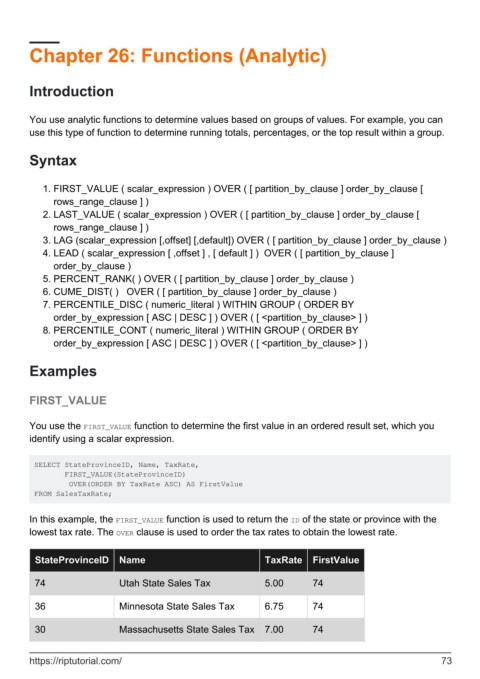
        In this example, the FIRST_VALUE function is used to return the ID of the state or province with the
        lowest tax rate. The OVER clause is used to order the tax rates to obtain the lowest rate.


          StateProvinceID      Name                                TaxRate     FirstValue


          74                   Utah State Sales Tax                5.00        74


          36                   Minnesota State Sales Tax           6.75        74

          30                   Massachusetts State Sales Tax       7.00        74


        https://riptutorial.com/                                                                               73

