


Page 93 - SQL
P. 93
SELECT statement, you can compare values in the current row with values in the following row.


        You specify the values that should be compared using a scalar expression. The offset parameter
        is the number of rows after the current row that will be used in the comparison.

        You specify the value that should be returned when the expression at offset has a NULL value using
        the default parameter. If you don't specify these parameters, the default of one row is used and a
        value of NULL is returned.


         SELECT BusinessEntityID, SalesYTD,
                LEAD(SalesYTD, 1, 0) OVER(ORDER BY BusinessEntityID) AS "Lead value",
                LAG(SalesYTD, 1, 0) OVER(ORDER BY BusinessEntityID) AS "Lag value"
         FROM SalesPerson;


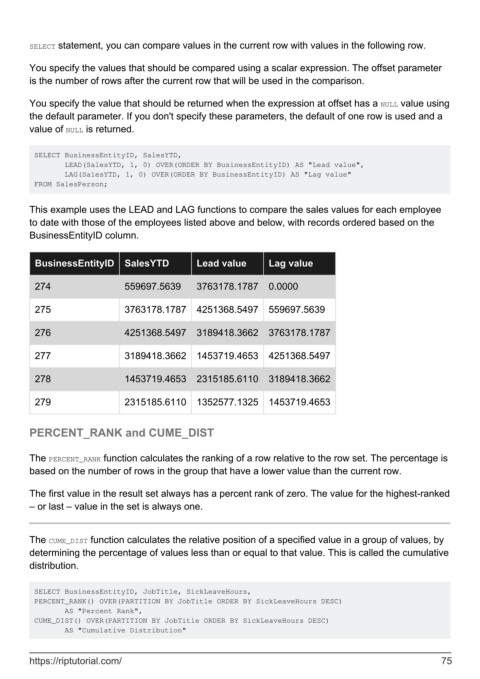
        This example uses the LEAD and LAG functions to compare the sales values for each employee
        to date with those of the employees listed above and below, with records ordered based on the
        BusinessEntityID column.


          BusinessEntityID      SalesYTD          Lead value        Lag value


          274                   559697.5639       3763178.1787      0.0000

          275                   3763178.1787      4251368.5497      559697.5639


          276                   4251368.5497      3189418.3662      3763178.1787


          277                   3189418.3662      1453719.4653      4251368.5497

          278                   1453719.4653      2315185.6110      3189418.3662


          279                   2315185.6110      1352577.1325      1453719.4653


        PERCENT_RANK and CUME_DIST


        The PERCENT_RANK function calculates the ranking of a row relative to the row set. The percentage is
        based on the number of rows in the group that have a lower value than the current row.


        The first value in the result set always has a percent rank of zero. The value for the highest-ranked
        – or last – value in the set is always one.


        The CUME_DIST function calculates the relative position of a specified value in a group of values, by
        determining the percentage of values less than or equal to that value. This is called the cumulative
        distribution.


         SELECT BusinessEntityID, JobTitle, SickLeaveHours,
         PERCENT_RANK() OVER(PARTITION BY JobTitle ORDER BY SickLeaveHours DESC)
                AS "Percent Rank",
         CUME_DIST() OVER(PARTITION BY JobTitle ORDER BY SickLeaveHours DESC)
                AS "Cumulative Distribution"


        https://riptutorial.com/                                                                               75

