


Page 161 - SQL
P. 161
FROM
             Employees
         JOIN
             Departments
             ON Departments.Id = Employees.DeptId


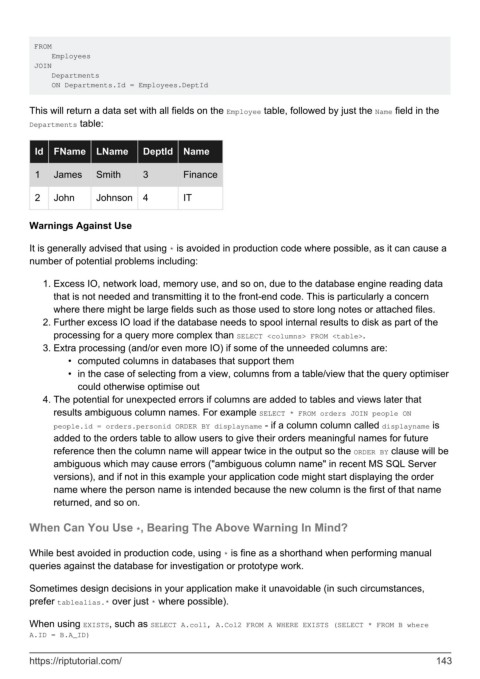
        This will return a data set with all fields on the Employee table, followed by just the Name field in the
        Departments table:


          Id  FName      LName      DeptId    Name

          1   James      Smith      3         Finance


          2   John       Johnson    4         IT


        Warnings Against Use


        It is generally advised that using * is avoided in production code where possible, as it can cause a
        number of potential problems including:

            1.  Excess IO, network load, memory use, and so on, due to the database engine reading data
              that is not needed and transmitting it to the front-end code. This is particularly a concern
              where there might be large fields such as those used to store long notes or attached files.
            2.  Further excess IO load if the database needs to spool internal results to disk as part of the
              processing for a query more complex than SELECT <columns> FROM <table>.
            3.  Extra processing (and/or even more IO) if some of the unneeded columns are:
                  •  computed columns in databases that support them
                  •  in the case of selecting from a view, columns from a table/view that the query optimiser
                    could otherwise optimise out
            4.  The potential for unexpected errors if columns are added to tables and views later that

              results ambiguous column names. For example SELECT * FROM orders JOIN people ON
              people.id = orders.personid ORDER BY displayname - if a column column called displayname is
              added to the orders table to allow users to give their orders meaningful names for future
              reference then the column name will appear twice in the output so the ORDER BY clause will be
              ambiguous which may cause errors ("ambiguous column name" in recent MS SQL Server
              versions), and if not in this example your application code might start displaying the order
              name where the person name is intended because the new column is the first of that name
              returned, and so on.


        When Can You Use *, Bearing The Above Warning In Mind?


        While best avoided in production code, using * is fine as a shorthand when performing manual
        queries against the database for investigation or prototype work.


        Sometimes design decisions in your application make it unavoidable (in such circumstances,
        prefer tablealias.* over just * where possible).

        When using EXISTS, such as SELECT A.col1, A.Col2 FROM A WHERE EXISTS (SELECT * FROM B where
        A.ID = B.A_ID)


        https://riptutorial.com/                                                                             143

