


Page 52 - SQL
P. 52
Chapter 12: cross apply, outer apply


        Examples


        CROSS APPLY and OUTER APPLY basics


        Apply will be used when when table valued function in the right expression.


        create a Department table to hold information about departments. Then create an Employee table
        which hold information about the employees. Please note, each employee belongs to a
        department, hence the Employee table has referential integrity with the Department table.

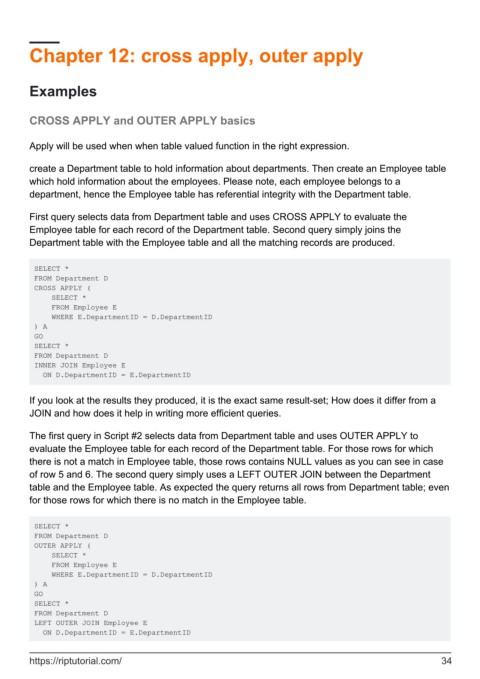
        First query selects data from Department table and uses CROSS APPLY to evaluate the
        Employee table for each record of the Department table. Second query simply joins the
        Department table with the Employee table and all the matching records are produced.


         SELECT *
         FROM Department D
         CROSS APPLY (
             SELECT *
             FROM Employee E
             WHERE E.DepartmentID = D.DepartmentID
         ) A
         GO
         SELECT *
         FROM Department D
         INNER JOIN Employee E
           ON D.DepartmentID = E.DepartmentID


        If you look at the results they produced, it is the exact same result-set; How does it differ from a
        JOIN and how does it help in writing more efficient queries.

        The first query in Script #2 selects data from Department table and uses OUTER APPLY to
        evaluate the Employee table for each record of the Department table. For those rows for which
        there is not a match in Employee table, those rows contains NULL values as you can see in case
        of row 5 and 6. The second query simply uses a LEFT OUTER JOIN between the Department
        table and the Employee table. As expected the query returns all rows from Department table; even
        for those rows for which there is no match in the Employee table.


         SELECT *
         FROM Department D
         OUTER APPLY (
             SELECT *
             FROM Employee E
             WHERE E.DepartmentID = D.DepartmentID
         ) A
         GO
         SELECT *
         FROM Department D
         LEFT OUTER JOIN Employee E
           ON D.DepartmentID = E.DepartmentID


        https://riptutorial.com/                                                                               34

