


Page 26 - SQL
P. 26
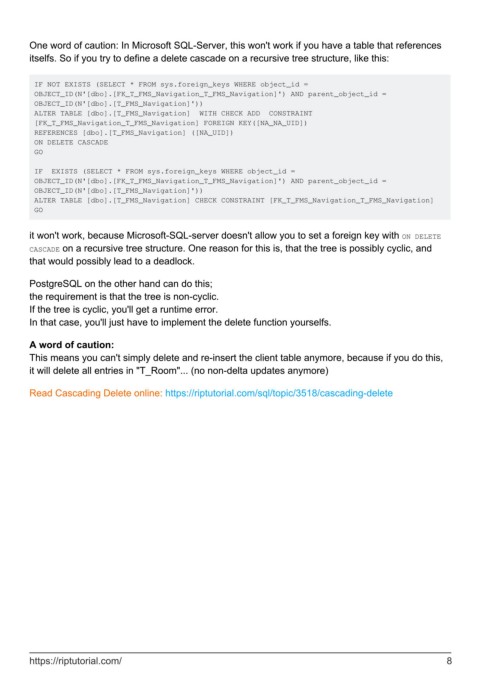
One word of caution: In Microsoft SQL-Server, this won't work if you have a table that references
        itselfs. So if you try to define a delete cascade on a recursive tree structure, like this:


         IF NOT EXISTS (SELECT * FROM sys.foreign_keys WHERE object_id =
         OBJECT_ID(N'[dbo].[FK_T_FMS_Navigation_T_FMS_Navigation]') AND parent_object_id =
         OBJECT_ID(N'[dbo].[T_FMS_Navigation]'))
         ALTER TABLE [dbo].[T_FMS_Navigation]  WITH CHECK ADD  CONSTRAINT
         [FK_T_FMS_Navigation_T_FMS_Navigation] FOREIGN KEY([NA_NA_UID])
         REFERENCES [dbo].[T_FMS_Navigation] ([NA_UID])
         ON DELETE CASCADE
         GO

         IF  EXISTS (SELECT * FROM sys.foreign_keys WHERE object_id =
         OBJECT_ID(N'[dbo].[FK_T_FMS_Navigation_T_FMS_Navigation]') AND parent_object_id =
         OBJECT_ID(N'[dbo].[T_FMS_Navigation]'))
         ALTER TABLE [dbo].[T_FMS_Navigation] CHECK CONSTRAINT [FK_T_FMS_Navigation_T_FMS_Navigation]
         GO


        it won't work, because Microsoft-SQL-server doesn't allow you to set a foreign key with ON DELETE
        CASCADE on a recursive tree structure. One reason for this is, that the tree is possibly cyclic, and
        that would possibly lead to a deadlock.

        PostgreSQL on the other hand can do this;
        the requirement is that the tree is non-cyclic.
        If the tree is cyclic, you'll get a runtime error.
        In that case, you'll just have to implement the delete function yourselfs.


        A word of caution:
        This means you can't simply delete and re-insert the client table anymore, because if you do this,
        it will delete all entries in "T_Room"... (no non-delta updates anymore)

        Read Cascading Delete online: https://riptutorial.com/sql/topic/3518/cascading-delete


        https://riptutorial.com/                                                                                8

