


Page 40 - SQL
P. 40
however, common table expressions can be used with recursion to emulate that type of function.


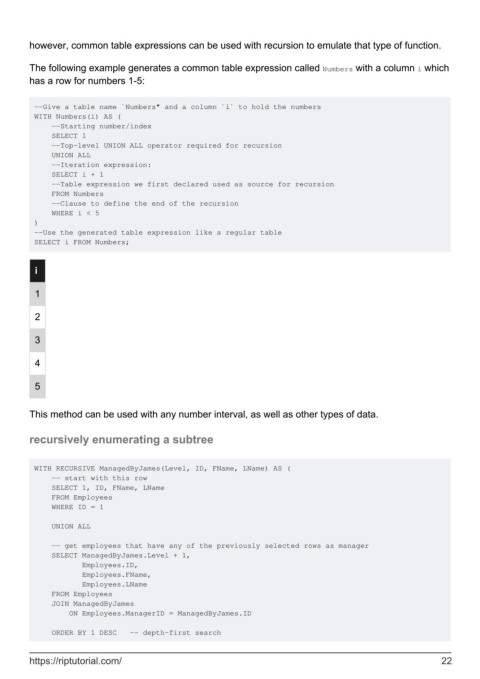
        The following example generates a common table expression called Numbers with a column i which
        has a row for numbers 1-5:


         --Give a table name `Numbers" and a column `i` to hold the numbers
         WITH Numbers(i) AS (
             --Starting number/index
             SELECT 1
             --Top-level UNION ALL operator required for recursion
             UNION ALL
             --Iteration expression:
             SELECT i + 1
             --Table expression we first declared used as source for recursion
             FROM Numbers
             --Clause to define the end of the recursion
             WHERE i < 5
         )
         --Use the generated table expression like a regular table
         SELECT i FROM Numbers;


          i


          1

          2


          3


          4

          5


        This method can be used with any number interval, as well as other types of data.


        recursively enumerating a subtree


         WITH RECURSIVE ManagedByJames(Level, ID, FName, LName) AS (
             -- start with this row
             SELECT 1, ID, FName, LName
             FROM Employees
             WHERE ID = 1

             UNION ALL

             -- get employees that have any of the previously selected rows as manager
             SELECT ManagedByJames.Level + 1,
                    Employees.ID,
                    Employees.FName,
                    Employees.LName
             FROM Employees
             JOIN ManagedByJames
                 ON Employees.ManagerID = ManagedByJames.ID

             ORDER BY 1 DESC   -- depth-first search


        https://riptutorial.com/                                                                               22

