


Page 124 - SQL
P. 124
Self Join


        A table may be joined to itself, with different rows matching each other by some condition. In this
        use case, aliases must be used in order to distinguish the two occurrences of the table.

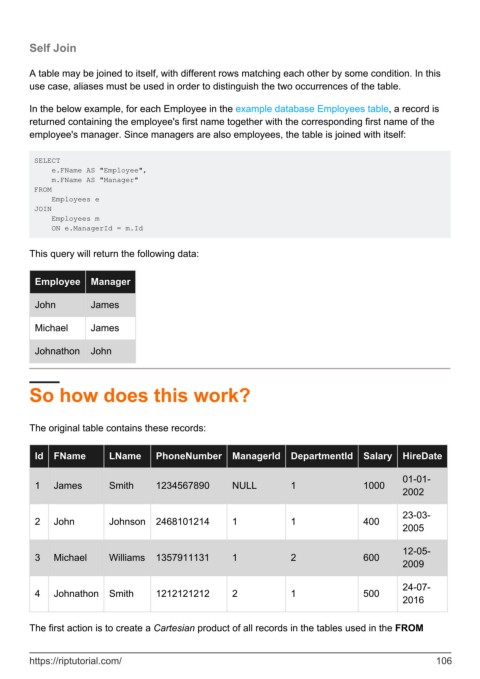
        In the below example, for each Employee in the example database Employees table, a record is
        returned containing the employee's first name together with the corresponding first name of the
        employee's manager. Since managers are also employees, the table is joined with itself:


         SELECT
             e.FName AS "Employee",
             m.FName AS "Manager"
         FROM
             Employees e
         JOIN
             Employees m
             ON e.ManagerId = m.Id


        This query will return the following data:


          Employee     Manager


          John         James

          Michael      James


          Johnathon    John


        So how does this work?


        The original table contains these records:


          Id  FName         LName       PhoneNumber        ManagerId     DepartmentId      Salary    HireDate


                                                                                                     01-01-
          1   James         Smith       1234567890         NULL          1                 1000
                                                                                                     2002

                                                                                                     23-03-
          2   John          Johnson     2468101214         1             1                 400
                                                                                                     2005


                                                                                                     12-05-
          3   Michael       Williams    1357911131         1             2                 600
                                                                                                     2009

                                                                                                     24-07-
          4   Johnathon     Smith       1212121212         2             1                 500
                                                                                                     2016


        The first action is to create a Cartesian product of all records in the tables used in the FROM


        https://riptutorial.com/                                                                             106

