


Page 100 - SQL
P. 100
Configuration and Conversion Function


        An example of a configuration function in SQL is the @@SERVERNAME function. This function provides
        the name of the local server that's running SQL.


         SELECT @@SERVERNAME AS 'Server'


          Server


          SQL064


        In SQL, most data conversions occur implicitly, without any user intervention.


        To perform any conversions that can't be completed implicitly, you can use the CAST or CONVERT
        functions.

        The CAST function syntax is simpler than the CONVERT function syntax, but is limited in what it can do.

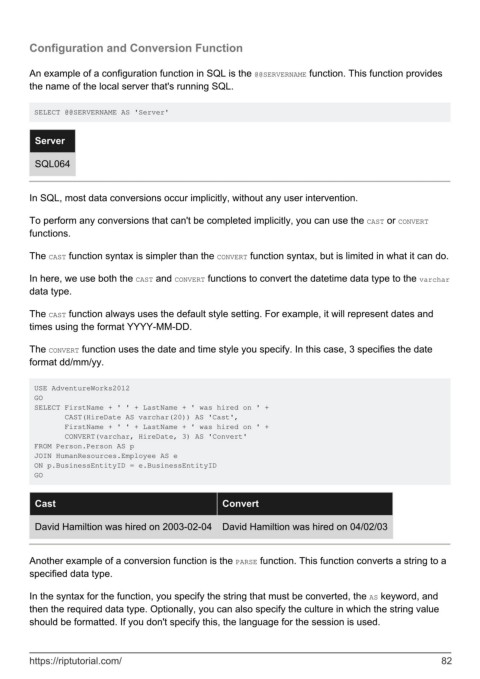
        In here, we use both the CAST and CONVERT functions to convert the datetime data type to the varchar
        data type.


        The CAST function always uses the default style setting. For example, it will represent dates and
        times using the format YYYY-MM-DD.


        The CONVERT function uses the date and time style you specify. In this case, 3 specifies the date
        format dd/mm/yy.


         USE AdventureWorks2012
         GO
         SELECT FirstName + ' ' + LastName + ' was hired on ' +
                CAST(HireDate AS varchar(20)) AS 'Cast',
                FirstName + ' ' + LastName + ' was hired on ' +
                CONVERT(varchar, HireDate, 3) AS 'Convert'
         FROM Person.Person AS p
         JOIN HumanResources.Employee AS e
         ON p.BusinessEntityID = e.BusinessEntityID
         GO


          Cast                                          Convert

          David Hamiltion was hired on 2003-02-04       David Hamiltion was hired on 04/02/03


        Another example of a conversion function is the PARSE function. This function converts a string to a
        specified data type.


        In the syntax for the function, you specify the string that must be converted, the AS keyword, and
        then the required data type. Optionally, you can also specify the culture in which the string value
        should be formatted. If you don't specify this, the language for the session is used.


        https://riptutorial.com/                                                                               82

